Monday, March 31, 2008

Leatherback Turtles


It’s strange to think that the Island of Trinidad would not be born for over 100 million years, when the leatherback turtles first roamed the oceans in the age of the dinosaurs. These massive sea turtles can grow to be 10 feet (3 m) in length, weigh over 2000 pounds (1000 kg) and live over a hundred years. The species has survived almost unchanged since the Jurassic era. They begin their life on land where they hatch from eggs, laid by their mothers in the sand above the high tide line. Shortly after hatching, they make their way to sea. The males never return to land but about half a dozen times between March and August, the mature females will laboriously drag themselves from their ocean home to build a nest and lay their eggs.

The islands of Trinidad and Tobago are the prime nesting site in the world for these amazing reptiles. Very little is really known about them since they spend nearly all their life at sea. Even their classification as reptiles is somewhat in question since they are able to regulate their body temperature. Our friends John and Margaret Cooper (UWI Veterinary Medicine) are leading a study of the nesting turtles in cooperation with local volunteer organizations that are working to preserve the species. Its not peak season yet but because Rich was here for only 10 days they helped us arrange a tour to watch the mother’s laying their eggs on the beach. I will go out with them again later in the season when the eggs are hatching to help them with their research.

We left St. Augustine a little after 5:30 pm and arrived in Matura on Trinidad’s east coast a little after 7:00 pm. Traffic is awful that time of day and the roads are terrible any time of day. I just got a car and so this was one of my first adventures in left side of the road driving but that’s another story. In Matura, John and Margaret delivered a bunch of supplies for the volunteers they work with and introduced us to some of their colleagues at Nature Seekers (a local group organized to protect the turtles). Nature seekers patrols the Matura beach each night from dusk to dawn during the laying season (March – August) to prevent poaching. They also guide tours and collect data on the turtles.

The turtle beaches are closed from sunset to sunrise during the egg laying season. To enter the beach at night you must have both a permit and a guide. Our guide, Ronald was fantastic. He was enthusiastic and regaled us with all sort of interesting information, like the fact that leatherbacks eat primarily jelly fish and have a special groove on their beaks for puncturing the man-of-war jellyfish. They roam hundreds of miles through the ocean and one was recorded diving over 4000 feet (4/5ths of a mile) below sea level before the depth sensor failed. When we went out to the beach around 8 pm the tide was out and Ronald told us that in his experience, the turtles usually come ashore with the rising tide, starting when the tide is about half way in. So we settle down on the beach.


The moon was nearly full and although it had rained hard on us during the drive, the sky was now dotted with only a few scattered clouds. It was wonderful just sitting in the warm night area watching the waves in the moonlight. Our tour group was quite small consisting of us, the Coopers, and a family from Germany with two young children. While we sat and waited, Ronald helped the children build a leatherback turtle in the sand taking the opportunity to teach the kids about the way they dug their nest, how they look and the ridges on their shells (leatherback turtles don't have plated shells like other turtles). After a bit, a second much larger tour group (over 2 dozen) came out to the beach and head down the beach to the south. The guides and patrols on the beach all carry radios so that if anyone finds a turtle, they can radio the other tour groups to come. We waited patiently on the beach for an hour or so. A bit after nine, John and Margaret decided they needed to head back to St. Augustine since John had an early morning class. They’ve seen many many turtles in their research and will be out studying them again in a few weeks so they didn’t feel the need to stick around late this night. Shortly after they left, Ronald decided that the tide had come in enough for us to start looking harder for turtles so we wondered south down the beach toward the other tour group for a while and then turned back north.

When we got back to our original sitting spot, Ronald and most of our group sat down to wait again but I thought I could see something dark on the shore ahead so Rich and I kept walking another few hundred feet. When we got closer, it became clear that the dark thing I’d seen was indeed a mother turtle coming ashore. We started waving and signally wildly to the rest of our group but they didn’t seem to be paying much attention so I ran back towards them while Rich kept an eye on the turtle. When I was about half way back to the group, they finally noticed my running and wild gesticulating, got up and started coming our way.

Ronald advised us all to stay about 40 feet (12 m) back from the turtle so as not to scare her off. When she was about half way up the beach, she decided she didn’t like the spot, turned and started heading back to the sea. Ronald then went over and had a chat with her and despite her reluctance he was able to persuade her to stay and lay her eggs for us. About the time she headed back up the beach, a second turtle starting coming ashore in almost the same spot. The two turtles settled in to dig their nests about 20 feet (6 m) from each other. Just about then, the second tour group, who’d been radioed by our guide, joined us.

The turtles began by excavating with their large front flippers throwing great arcs of sand away from their site. Once they’d dug themselves in about 8 inches (20 cm), they began digging the nest itself with their smaller rear flippers. At this point, the turtles become so intent on what they are doing that they are doing that they aren’t disturbed by humans so we were permitted to get up close to the turtles digging their nests. The turtle would take one of her rear flippers and run it around the bottom of the whole kind of like I might scrape the bottom of a mixing bowl with a rubber spatual, she would close her flipper around the loose sand almost like it was a hand and pull the sand out of the hole. She’d then repeat the process with the other flipper until she’d dug an almost perfectly cylindrical whole about 10 inches (25 cm) in diameter and maybe 20 inches (50 cm) deep.

When the nest was as deep as she could readily reach with her rear flippers, she began laying her eggs. Once the turtles begin laying their eggs they go into a trance like state and are virtually unaware of anything going on around them. At this point, we were allowed to take flash photos and even touch the turtle (see slide show below). Once she started laying, Ronald straddled her back to take her measurements and read the transponder chip that had been put in her during a previous season. He read the tags on her rear flippers while she was digging the whole. Our turtle (the first one that came ashore was 142 cm long, a bit on the small size and the other turtle was 153 cm long, just about average. Turtles usually lay 100 to 150 fifty eggs with yokes in a nest and then some smaller eggs without yokes. No one is quite sure what the purpose is of the smaller eggs. The eggs are spherical with soft leathery shells and a little bigger than a golf ball. The newly laid eggs were moist and glistened in the moonlight. Our turtle laid a truly impressing number of eggs, close to 150 fifty and then began covering them with sand using her rear flippers. Once she was satisfied that the eggs were adequately buried she began flinging sand about wildly with her front flippers. She slowly turned her self about flinging sand every which way as she went and ultimately creating a ring of disturbed sand at least 12 feet (4 m) in diameter and making a number of decoy nest sites along the way. By the time she was done, it was impossible to tell where in all that mess she’d laid her eggs even though we’d been right there watching the hole times.
(Note: To see a larger version of the slide show, click on the title (Turtles))


Having finished her task, our turtle began to slowly make her way back to the ocean. She seemed totally spent. The entire process had taken her over 2 hours. Even through our turtle started and finished laying her eggs before the other turtle, she took longer camouflaging the site so by the time she started back to the ocean, the second turtle was gone. First on the beach, last off. She slowly, slowly dragged her tired body that was not truly meant for maneuvering on land back toward the water. She hit the waters edge. One small wave came in and carried her out a couple of feet and she paused a moment. Then a bigger wave crashed over her and she was gone.

Friday, March 28, 2008

Monos Island

Sorry I haven’t updated the blog in a while. I’ve been busy doing lots of uninteresting stuff like preparing lectures, writing the proposals, flying to the US for meetings and packing up our house in Utah. But the last couple weeks have been a lot more exciting. Rich was here for spring break. He arrived last Thursday night (March 13) in time to rest up for Saturday’s (March 15) Trinidad and Tobago Field Naturalist Club (TTFNC) botany group outing to Monos Island.

The Trinidad and Tobago Field Naturalist Club is a group dedicate to preserving and enjoying the natural environment of the country. The clubs mission is “to foster education and knowledge on natural history and to encourage and promote activities that would lead to the appreciation, preservation and conservation of our natural heritage.” I’m now a member and I’m anticipating Rich will be too when he actually gets here permanently. The club has monthly evening business meetings in Port of Spain with a featured speaker on issues relevant to the club. I’ve been to two business meetings now. At the first one, the featured speaker is running an organic agriculture and resource restoration project in one of the valleys (Caura) in the northern range. This month the speaker was a UWI researcher doing a coral reef restoration project.

The club also has special interest groups on birds, insects, botany, and environmental issues and sponsors regular field outings. Saturday (March 15) was the botany group outing to Monos Island. If you look at a map, you will see that there is a string of three islands coming off the tip of Trinidad’s north west peninsula extending over toward Venezuela, these are known as the Bocos islands. The one closest to Trinidad is Monos Island. Its name stems from the monkeys that once lived there but there are no monkey’s on the island now. Just to the south of Bocos Island is a forth island, Gaspar Grande. Most of the rain in Trinidad comes from the north east off the Atlantic which puts the Bocos islands in something of a rain shadow. The vegetation there is adapted to a much drier climate than what is found in the northern range. There are many cactus and deciduous trees that loose their leaves during the dry season. By southwestern US standards, its very didn’t seem very dry and the vegetation was nearly as dense as the rain forests, just dominated by different species.

We had to get up shortly after 5 am in order to meet the club in POS by 6:30 am. Then we drove out to Williams Bay on the north west peninsula where all 24 of us packed onto an open boat, put on life vests and headed up the coast and across the Boca to Monos Island. The red X on the map of Monos Island below shows the approximate location where the boat dropped us off. From there we hiked along the shore to the base of the little bay and then a ways up the valley (yellow line).


The whole Island is less than two miles across so it wasn’t a very long hike but then we weren’t there to hike and weren’t moving very fast either. We were there to survey the vegetation growing on the Island. We had a couple of guides with expertise in the local vegetation including the expert from the UWI Herbarium as well as several very experienced club members. When we got off the boat we had a not so brief overview of our objectives for the day including a long list of plants that had been documented previously on the island and some particular plants we were looking to find.

Rich and I weren’t of much use identifying plants since this is a totally new ecosystem for us. We did however learn a lot. Some of things I think of as solely domesticated house plants like philodendrons, croton, sansevieria and many orchids grow all over hear in the wild. Along the shoreline there were all these holes that looked for all the world like gopher holes. It turns out they are dug by crabs. There are these little tiny geckoes that like to live between the trunks and leaves of young palms. We were shown two species of orchids that grow on the Island although neither of them was currently in bloom. The seeds of them is transported to Trinidad from Africa with Saharan dust storms and Rich is anxious to see if we can use it to track areas that are impacted by the dust.

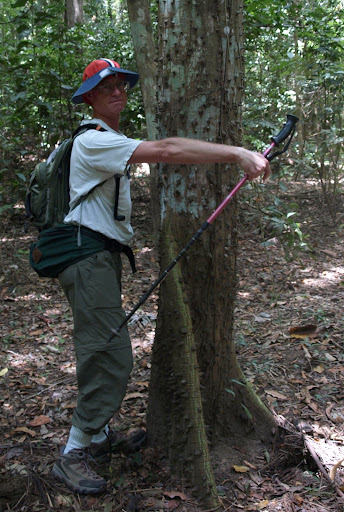
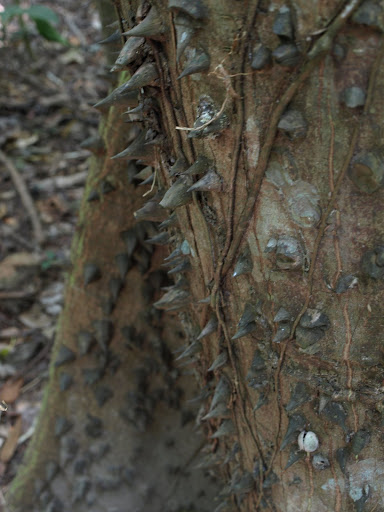
I even remember the names of some of the plants we learned. Here are a few of them. Below is picture of a silk cotton tree (Ceiba petandra) also known as Kapok. The trunk of this tree is covered with huge thorns, enough to scare off all but the most intrepid tree hugger. It is reputed to have large read flowers, but it wasn’t blooming this time of year so I can’t confirm. The fruits of the tree produce a cotton like fiber (Kapok) which is used as a batting and stuffing in some parts of the world. Rich remembers cheap sleeping bags made with Kapok from his childhood. The tree has never been grown commercially in the carribean but seems to grow all over Trinidad. There are lots of superstitions associated with the silk cotton tree. At one time people believed these trees could move around and gather together (like Ents!).


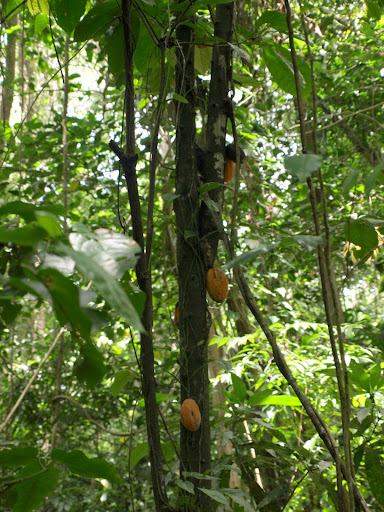
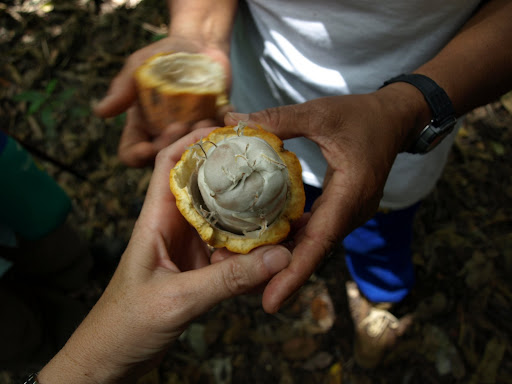
The tree pictured below is “Theobroma cacao”. That’s right, it’s a Cocoa tree. The yellow fruits growing from the trunk contain cocoa beans. The second picture is of one of the pods broken open so you can see the cocoa beans. We sucked and chewed a bit the fresh cocoa beans. The white stuff on the outside of the beans is sweet and quite tasty but doesn’t taste anything like processed cocoa. The beans have to be fermented and roasted before they take on the characteristic chocolate flavor.


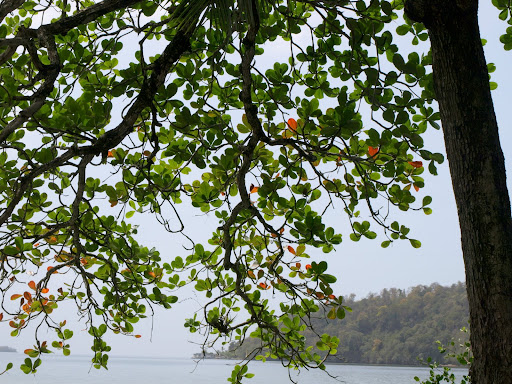
The next picture is of the tropical almond. The nuts from this tree were scattered all over the ground near where we ate lunch. The shells don’t look quite like domestic almonds but one of our guides was able to break a few open and the nuts themselves look and taste just about like domestic almonds. We’ll have to bring along tools to crack them open on future costal hikes. The nuts from the tree float well so the tree is found throughout the tropics. As a side note, I remember seeing this tree and the nuts in Hawaii but everyone I asked about them told me they weren’t nuts and weren’t edible. Just goes to show you shouldn’t believe everything you hear.


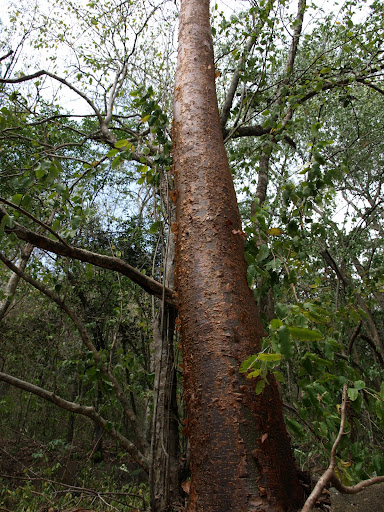
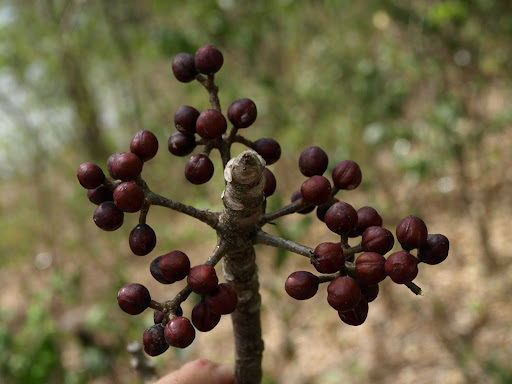
The two pictures below are of a tree called “The Naked Indian” (Bursera simaruba) and its berries. There are two species of this tree that grow in this area and one of our goals was to find if both of the species were present on Monos Island. Only one had been confirmed in the past but they are easy to confuse. Both species have the same peeling bark, which earns the tree its name. There are distinguishing features in the leaves and the fruits. Unfortunately, most of the trees had lost their leaves this time of year which made the job of distinguishing the two trees more difficult. Some of the trees had berries on them. Dan, one of the experience TTFNC members, is incredibly good at throwing rocks and stick accurately enough to knock samples of things like berries off really high branches. The berries of the naked Indian are used in incense and have a pleasant juniper like smell. Toward the end of our expedition, we did find one Naked Indian with leaves down low and our expert was able to identify it definitively as the second species that hadn’t previously been confirmed on the Island which made everyone happy.


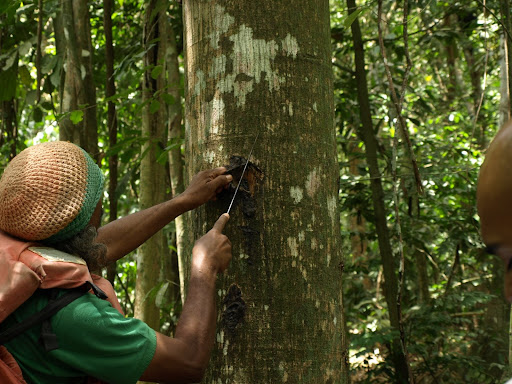
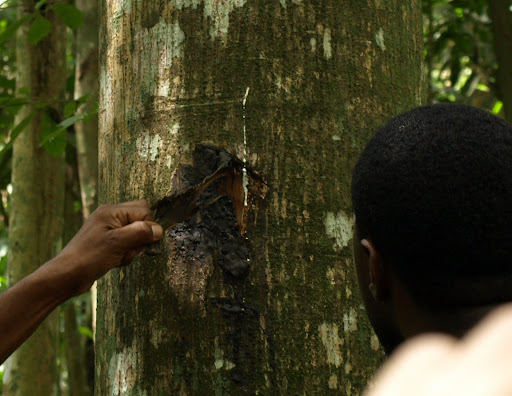
One of the more interesting things we came across was a rubber tree. This isn’t the most common commercial rubber tree but it does produce usable rubber. In the first picture below you can see Dan pulling on some old oxidized rubber stuck to the trunk of the tree and cutting a small gash in the tree with his machete. In the second picture you can see the free rubber latex running down from the spot where Dan cut the tree. Evidently the latex will keep running like this for about a day after the tree is cut.


When it hit noon, we quit working and limed (Trini for hanging out) a bit on beach at the bottom of the bay. We ate lunch, visited and swam in the bay, then headed back to our drop off point to meet the boat at 3 pm. It was a successful trip for TTFNC. We identified several plants that haven’t been recorded on Monos Island previously, found a number of things even our experts couldn’t identify off hand and collected pictures and samples to take back to the herbarium for identification. Rich and I learned a lot of stuff about our new environment and started some friendships with a bunch of people that have common interests. All in all a wonderful day!

Tuesday, February 12, 2008

Carnival Tuesday


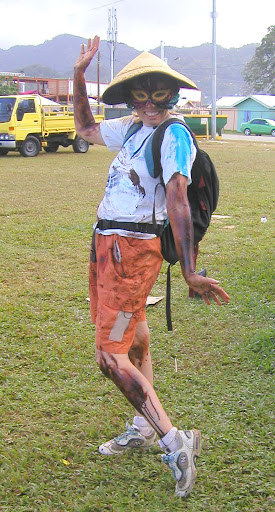
Although I’m certain any Priest would denounce the idea, one of the points of Carnival is to do something you’ll regret the next morning, leaving you in a properly penitent spirit for the beginning of Lent. The picture to the left should explain what I regretted Wednesday morning. While improper application of sunscreen may not be one of the sins most commonly associated with Carnival, it is much more in keeping with my Mormon values than excessive drinking and lascivious sex and I do thoroughly regret it.

I spent the day on Tuesday with Cornelia, a friend from church, and her family. She came by and picked me up mid-morning and then the two of us and Cornelia’s two daughters were invited to swim at her neighbors home. It was a beautiful sunny morning with temperatures in the low 80 F and swimming in the private salt water pool was most enjoyable. Then we joined Cornelia’s extended family for the afternoon of eating traditional Trini festival foods and watching the mas on TV.

I’m sorry I can’t tell you what its like to be in the middle of all the reveling in Port of Spain, that will have to wait until next year when Rich is here. I can however tell you a bit about what goes on and I’ve included pictures of some of the elaborate costumes. The Carnival Mas is organized into bands. The heads of each band start planning themes and costume designs typically 6 months or more in advance of Carnival. Each band has a king and queen who wear costumes that are so elaborate they are better described as human born parade floats than costumes. These costumes are often over 20 feet tall and equally as wide. Many are designed to be very light so that they can be carried by a person. Others have wheels that support much of the weight. One of the more elaborate king costumes this year which I did actually get to see in person was called “Iguana of the Night”. There is a picture of it in the slide show.


It’s an enormous mechanical iguana wearing a sombrero. The iguana bends up and down at the hips as its wearer maneuvers the costume around. Very impressive. The bright pink costume you see in the slide show is from the youth competition (yes she is a teenager). In the youth competition, the competitors have to carry the full weight of the costume so there is a lot of ingenuity that goes into designing these enormous things to be light enough that they can be easily carried by the young people.

Following the king and queen will be a truck carrying either a steel band or loud speakers blaring Soca music and hundreds to thousands of costumed revelers. Pretty much anyone can join a band but it is quite expensive. Costumes run in the hundreds of dollars and you have to get the costume designed and produced by your band. The band directors are licensed by the government and responsible not only for the theme and costume design but also to keep their band more or less orderly. I say more or less because while crime and vandalism are strongly discouraged, lewd behavior is pretty much expected. The bands of revelers dance and wine along the carnival route from morning until after sunset. People who are planning to play mas often start training for the event in the fall and this isn’t just so that they will look good in their skimpy costumes, dancing for 8 hours straight takes some stamina.

So that’s it for this year’s Carnival celebration, well except for the after Carnival shows. I’ll write a bit about them soon. Next year when Rich is here perhaps we can give you a first hand account of the Bacchanal.

Monday, February 11, 2008

J’ouvert (pronounced Jew-vay)


At 4:30 am on Carnival Monday, the Cooper’s picked me up. They both had their faces painted black and were wearing their oldest clothes. I was dressed in an old T-shirt given me by a friend at church and Rich’s orange shorts which I had to tie up with string to keep them from falling off. Margaret and I had feathered masks. All appropriately dressed for the occasion, we headed in to Port of Spain to play J’ouvert. If you dress up and join a mas (local for masquerade parade) rather than just watching, it’s said that you “played Carnival”.

Each Carnival mas is organized into bands. Each band includes banners, a king and queen, a large truck that carries either a steel pan band or an enormous sound system blaring Soca music, and costumed revelers that can number into the thousands. J’ouvert is the first Carnival mas and begins in the pre-dawn hours of Carnival Monday, hence our very early departure. It originated as the poor peoples answer to the elaborate parades and costumes that comes later in the celebration. People come in simple homemade costumes that often consist of little more than old clothes mud and paint and the custom is to get dirty. Many of the bands have a big bucket of mud, paint, oil or even chocolate for their players to smear on themselves, each other, or anyone they can find, hence the old clothes.

We arrived in Port of Spain a bit after five, parked at the Zoo and went in search some bedlam or Bacchanal. Rather than joining one band, Margaret and John like to move from band to band so they can see more of the festival. They made some changes to the event this year and had several smaller J’ouvert celebrations in some of the neighborhoods of Port of Spain so the main celebration by the Queens Savannah was by all reports much tamer than it has been in past years. After a while, John became concerned that I might not even get dirty and he began going around asking revelers to smear some mud or paint on me. In the end this turned out to be rather unnecessary as I got my share of mud, paint, and oil. At one point I had my hands covered in chocolate up to my elbows and was smearing it on people who looked a bit too clean.

In addition to the general mud slinging, j’ouvert involves a lot of dancing, jumping and wining (a Trini dance move that involves wild gyration of the hips) as the bands make their way around town and past the judging points. We moved around from band to band until things started to wind down about an hour after dawn. We then found some breakfast, corn soup and hot dogs from one of the Carnival vendors and some ice cold coconuts from a truck. Eventually we found our way back to the car and then Cooper’s house in St. Augustine where we sat on the Veranda, ate papaya and water melon and visited for a while before I headed home to wash up. Take a look at the slide show to see some the j’ouvert mas.

Saturday, February 9, 2008

Extempo and Calypso

Extempo

Last Thursday I was invited to go with some friends, John and Margaret Cooper, to the Extempo competition. Extempo is one of the traditional forms of Calypso. Authentic Calypso (also called Kaiso) is quite different from the popular forms you hear sung by people like Harry Belafonte. It developed during Colonial times among the slaves as a way to spread the news and avoid censorship. A good Calypsonian had not only to be able to sing but also to be able to make up new lyrics quickly complete with rhythm and rhyme. Calypso became the forum where you could say things that would get you in trouble any place else. Songs involve a lot of humorous but biting political and social commentary as well as comedy and sexual innuendo. Double entendre, word play and even puns are an important part of the art form.

Extempo is a test of a Calypsonians ability to do all those things on the fly. In the first round, there were eight competitors. In turn, each competitor drew a topic from a hat. The topic was read aloud for the audience and the judges. The band then started up with the classic Extempo melody and after about 15 seconds of music, the singer had to sing 4 verses on the topic. They were judged not only for clever on topic lyrics but also good rhythm and rhyme. In the first round the topics were all based on recent local news items. Some dealt with characters and events from the recent elections, others dealt with the recent crime wave and gangs. One singer drew the topic “Too much bikini in mas”, a frequent complaint made about the skimpy costumes worn by many in the Carnival parade. Another drew the topic “Brian Lara is back”. (Brian Lara is the Trinidadian hero of Cricket).

Following the first round, four singers were chosen to advance to the semi-final round where they were paired off against each other. Each pair drew a topic from the hat. The first singer would sing a verse on the topic and then the other had to sing a verse in response. They alternated back and forth until each singer had sung 4 verses. In this round the topics were designed to provide the singers ample opportunity both to boast of their own virtues and insult their opponent. The first pair drew the topic “personal hygiene” and the second “I could teach you Extempo”. The best two singers from this round advanced to the finals which was organized the same way except that each singer got 6 verses to prove his superiority to his opponent.

The final two singers were an older man who goes by the Calypso name of “Short Pants” and a younger man who goes by “Lingo”. Evidently, Lingo had been a student of Short Pants and it was evident that the two knew each other well and were skilled at playing off each other. Their verses had the audience roaring with laughter. In the end, Lingo won the crown and composed one last verse as an acceptance speech.

In between the Extempo rounds, we were treated to the final competitions in several of the Calypso categories including political commentary, social commentary, comedy, soca chutney and vintage Calypso. The winner of the political commentary did a parody of the opposition leader who lost the recent elections. In the vintage Calypso category the winner sang a song much of the audience knew very well called “Two at Twenty-five” which is about the woes of having a 50 year old wife. The title gives you a hint at the remedy the song proposes.

Friday night I went out with the Coopers and a group for their friends to a Calypso Tent just down the road in St. Joseph. A Calypso Tent is a show featuring a Calypso band made up of brass instruments, bass, keyboard and drums and a variety of singers who perform a mixture of new songs written for this year’s carnival as well as classic numbers. Once upon a time Calypso Tents were actually held in Tents but now they are held in theaters and halls. The show featured several younger singers who had qualified for the finals in the King of Calypso competition to be held on Carnival Sunday as well as older singers performing vintage Calypso. To qualify as a Vintage Calypsonian you must have to have been performing Calypso for over 40 years. The newer numbers contained a lot of social and political commentary. The best one, at least in my opinion, was titled “I’m sorry” and was the tale of a father apologizing at the grave of a son killed in a gang fight for not being more involved in his sons life. The vintage Calypso was all of the humorous and often racy variety. I suppose that political and social commentary go out of fashion much faster than laughter and sexual innuendo. One of the funnier Vintage numbers was called “The Boogie Man” and was about an exhibitionist in the Carnival parade.

All this was tied together by a young Master of Ceremonies who did a bit of stand up comedy between the numbers. He started off wearing a Cowboy hat, imitating a Texan drawl and making jokes about American culture. As the night wore on his act got a quite vulgar at points. Enough so that the Coopers who had invited us all along were quite embarrassed but not so much that it spoiled the fun of the evening for me.

Carnival in Trinidad

In Trinidad, where it’s summer twelve months a year, they say the seasons are defined by the holidays rather than the weather. Since the beginning of January it has been Carnival season. The Carnival celebration in Port of Spain is reputed to be one of the largest in the world, second only to Rio. When you consider that the city proper of Rio de Janeiro has a population of over 6 million and the entire country of Trinidad and Tobago has only 1.3 million, you can get an idea of how all consuming this event is for the country. Everyone seems to get involved at one level or another even if it’s only to complain about degeneration of morals during the season.

Like Mardi Gras in New Orleans, the pre-Lenten Carnival was brought to Trinidad by the French but here Carnival isn’t a simple Fat Tuesday celebration or even a long weekend Celebration. It’s a full season of party and competition culminating in Carnival Sunday, Monday and Tuesday. Parties or Carnival Fetes start up right after the new years parties finish. During the season there are a myriad of shows and events as the steel pan bands, Calypsonians and the rest prepare for competitions. The competitions are staged with the best performers progressing to semi-finals and finals which take place during the 2 weeks prior to the big parades. Carnival Monday and Tuesday are unofficially public holidays and virtually all businesses, offices and schools in the country are closed. About half the population don’t show up for work or school on Wednesday either. The tail end of Carnival week features follow up shows featuring the highlights and winners of all the competitions. In the coming days, I’ll post about the things that I’ve done for Carnival.

Tuesday, January 22, 2008

Trinidadians or "Trinis"

Since Rich went back to the states things have been a lot less like an adventurous holiday and a lot more like work. Luckily, people here are very friendly so even though I miss my husband desperately, I’ve met quite a few people who are helping me keep from being terribly lonely.

The very first thing that struck me here was how friendly the people are. Trinis like to chat and laugh and all of them that I’ve met have been warm and friendly. Woman commonly greet each other with an embrace and a kiss on the cheek. The people I’ve met so far divide up more or less into three groups: people I work with at UWI, my neighbors, and people I’ve met at church.

Noticeably missing from that list are the UWI students. Classes started last Monday and the campus is now filled with students. I am team teaching two classes this semester but my lectures don’t come until later in the semester, so although I have been to both classes and seen the student’s faces, my interaction with them so far has been very limited. The teaching staff members in Chemical Engineering are a very international group. We have people from Nigeria, Iran, Nicaragua, England, Barbados, me from the US and even a few from here in Trinidad. My department head, Dr. Bobby Pilgrim met us at the airport and took us straight to his house to eat Christmas leftovers and meet his family. He has been very helpful showing Rich and I around and helping me get settled.

UWI arranged a furnished house for us so we had a home to move into the day we arrived. We live in a gated community that consists of a row of 15 townhouses that is about a 20 minute walk from my office. Our place is right in the middle. Most, but not all, of the people who live here are associated with UWI. Our neighbors to the left in are a family from England who’ve been here for about 6 months. Katie, the mother, is a lecturer in the English department and Justin, the father is in film studies. Katie is a blond haired Anglo Saxon type but Justin, although he was raised in England, is a Trini with African ancestry. They have 3 children, Kip (5), Lily (4) and Nive (3), who get up early in the morning to ride their baby bikes up and down the short street and jump on the Trampoline in the common garden. Living on our right, we also have three children Chantel (~12), Nathan (8) and Justin (2). Their mother, Annabelle, is a lawyer and a native of Trinidad. Annabelle is very cheerful and fun to chat with. Justin has a large collection of toy cars and Nathan thinks bugs and lizards are really creepy. All six children play together on the street and in the common neighborhood garden. They keep me informed about all the important neighborhood news like Nive’s birthday party and the snake someone saw in the yard. Prof. Hongloo and his wife Sherika (sp?) who are from Kashmir live two doors down. He is a professor of history and she is in physics. He is here teaching South Asian studies on exchange from the Indian government and his expertise is in the history of northern India and Pakistan. They’ve invited me in several times to chat and have told me I should drop by when ever I get lonely. There are several people in the neighborhood who I’ve met (2 from India, and 1 from the US) who are working with the UWI veterinary medicine program and one gentleman from England who is in Civil Engineering.

I am what they call here in Trinidad “churchy” meaning that I go to church regularly. There is a lot of religious diversity in Trinidad. Walking around the area you can see a Muslim Mosque, a small Hindu temple, and a wide variety of Christian churches. Among the Christians, Catholics are the most numerous but I’ve seen many other churches around. Mormons make up only a tiny part of the mix. I’m lucky to live a 15 minute walk from the Curepe branch which meets in rented rooms above some shops. On the Sundays I’ve been there, we have had 50 to 60 attending. The church is relatively young in Trinidad so most of the members have been in the church for a few years at most. The first thing they asked me when I said we were moving here was “do you play the piano”. Sadly, I think I am the best piano player in the branch. Or I was the best piano player in the branch until last week when we were joined by a family from the states who will be here for the next six months. The mother in the family has taught piano lessons so I figure I’ve got six months to practice before they will need me to try to accompany the singing. Last week I started teaching early morning seminary classes for the high school age students. I teach 2 mornings a week at 6 am. I had 4 students the first morning I taught and 5 the second. The teenage girls in our branch are a strikingly beautiful bunch. We have one girl who leads the singing in sacrament meeting who, in Rich’s words, could be a super model and several others who are every bit as pretty.

I find it very interesting to study the faces of people here. There is so much diversity. When Columbus first visited Trinidad it was settled by the Carib. For the following three centuries it was a Spanish colony but Spain had a difficult time keeping colonists in Trinidad because they preferred the gold and silver rich territories in Peru and Mexico. Eventually they invited French planters to run many of the tobacco, cocoa and sugar plantations. Like most of the Caribean, slavery has been part of this countries history from virtually the moment of Columbus’ “discovery”. Slave traders followed on Columbus’ heels to capture and sell the Carib. Then when the Spanish colonists arrived, they were “given” the Carib in an arrangement much like European serfdom. After the Carib had been nearly wiped out by disease, over-work, mistreatment, executions and war, the colonials began importing slaves from Africa. During the French revolution and reign of terror, many more French, both royalists and republicans, sought refuge here from other places in the Caribbean. The British saw the growing French presence in Trinidad as a threat to British control of the region and seized control of the Island in 1797. It remained a British crown colony until 1962 when Trinidad and Tobago became an independent nation. When England abolished slavery in 1838, the blacks who had worked in the fields migrated to the cities and refused to do farm labor. To fill the labor shortage, the English brought in indentured laborers mostly from south Asia (today’s India, Pakistan, and Bangladesh) but also a few from China, Portugal and Ireland. The last two groups of immigrants were Syrians who came around 1913 to escape religious persecution in Lebanon and Jews who settled in Trinidad during WW II. You can see the contribution of all those different people, Carib, Spanish, African, French, English, Chinese, South Asian etc) to the names and faces on the island. On the books the population is said to be approximately 40% East Indian (as distinguished from West Indian and Amerindian), 40% African, and 20% other with less than 1 % white but looking at the faces the divisions are much less clear. Although almost everyone has dark hair and dark eyes, skin color varies from almost as light as mine (rare) to charcoal black and everything in between. There is an enormous variation in facial features and there are many strikingly beautiful people. Rich often jokes that “white people all look alike”. After studying people’s faces, here I have to say he’s right.

Sunday, January 20, 2008

Good Bug, Bad Bugs

The tropics have a reputation for bugs. I’ve heard a lot of people say, “You’re moving to the tropics with all those icky bugs?” Well you’ll be pleased to know that there don’t seem to be any more bugs here than other places I’ve lived. Of course when I say that, you must realize that my pantry in Salt Lake was infested with pantry pests (moths), Montana is over run with tics and mosquitoes during the warmer months and I got Lyme disease twice in northern Europe. So far the worst I’ve experienced here are some tiny ants that like to come through the back porch and into my kitchen and the odd mosquito that comes through the unscreened windows to bite me while I sleep. Most of the bugs around are what I’d call “good bugs”.

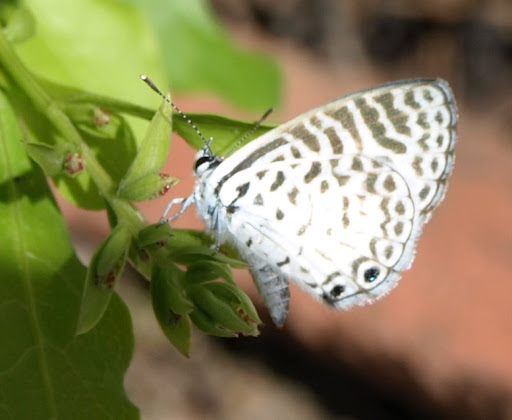
Trinidad is reputed to have hundreds of species of butterflies. While I haven’t seen that many different kinds, I do regularly see several different butterfly species on my morning walk to work. The species I see most commonly is a red and black butterfly called a coolie that frequents the flowers that grow in the drainage ditches.


I also see quite a few common yellow butterflies and small yellow butterflies with black tipped wings. Occasionally I see others as well. Earlier this week I saw one of the Monarchs that migrate here from North America during the winter months. I have no idea how a butterfly can make it this far south. Even following the chain of islands, there is a lot of open water to cross and with the occasional tropical storm or hurricane to boot. It’s hard to imagine how something as delicate as a butterfly could make it through all that.


In addition to the butterflies, I see a lot of different kinds of dragon flies. The large blue and purple ones that like our little neighborhood seem almost as big as the hummingbirds that visit the wild sage bush in our yard. Last night when I was coming home just about sunset, Hongloo and Sherika (a visiting professor from India and his wife who live 2 doors down), were sitting out on their porch. They invited me to visit for a while. While I sat with them watching the sunset, I discovered that we have fireflies here. There aren’t as many of them as I remember seeing in Pennsylvania summers as a kid, at least not at this time of year, but I did see a few of them lighting up hovering around the Mango trees.

Thursday, Annabelle, the lawyer who lives with her three children between our place and Hongloo’s, gave me some poisonous white powder to sprinkle along the edge of the back porch as a barrier to the ants. I sprinkled a thin line of it all along the edge of the back porch and thus far it’s been keeping the ants at bay. The troop of ants that had found its way under the back door, along the baseboards and up the wall into my cupboard is all gone. So right now I’m thinking that tropical bugs just aren’t that formidable and in fact, many of them are downright lovely.

Monday, January 7, 2008

Pitch Lakes, Hindu Shrines and Scarlet Ibis

The chemical engineering department arranged a tour for us Saturday. We ended up having a private tour because the tour guide who works with engineering didn’t have a tour group arranged. The guide picked us at our flat at 8 am and we headed south. We live on the southern edge of the islands northern mountain range. South of us, is a large flat valley covering central Trinidad and yet further south is another range of mountains (hills really). Our first destination was La Brea and the Pitch Lake on the southwest peninsula. Trinidad is home to the world’s largest asphalt lake covering 40,000 square kilometers, which locals refer to as the 8th wonder of the natural world. Sir Walter Raleigh was the first European to visit the pitch lake in 1595 and discovered that it made excellent caulking for his ship. Interestingly the Carib (Amerindian) name for the pitch is “piche” which is likely the source for the English word. Walter Raleigh reported the find to Queen Elizabeth and the lake became something of an attraction. After Port of Spain, the capital of Trinidad, burned in 1808, it was rebuilt with streets paved with pitch from the lake, making it the first city in the world to have asphalt paved streets. Pennsylvania Avenue and the road in front of Buckingham palace are both paved with asphalt derived from Trinidad’s pitch lake.

We were pleased to find that Pitch Lake is a lot less like a giant parking lot than we expected. Much of the lake has soil and vegetation covering the pitch. The town of La Brea is actually built on a portion of the lake. This isn’t necessarily a good thing since the pitch isn’t stable. Many of the buildings, some of them elaborate mansions, are leaning because the pitch beneath them shifted. We were given a walking tour of the central region of the lake where pitch is being mined. The exposed area of the pitch lake is in a depression surrounded by cashew trees and wetlands. There are beautiful blue and pink lotus flowers growing in the ponds along the side of lake. To get out on the asphalt, we had to wade in water that was sometimes knee deep and then we set out bare foot across the asphalt. As we walked, we had to keep jumping across places where deep seems in the asphalt had filed with water. Most of the lake is solid enough to walk on without problems but there are patches where lighter oils are bubbling up from below. Our tour guides steered us around those spots. Methane and a bit hydrogen sulfide are bubbling out of the asphalt which is most obvious where there are pools of water. You can see patches of sulfur on the surface of some of the puddles. During our tour, there were half a dozen black vultures hanging out or “liming” as they call it here in the middle of the pitch lake. I’m not sure why they like it there except perhaps that its good camouflage. Luckily for us, it had rained shortly before our walking tour so the temperature was moderate. I suspect it can get pretty hot out in the middle of the asphalt in the tropical afternoon sun.


Following our walking tour of the Asphalt lake, we turned north to an area along the central coast where there are two Hindu temples. The first, called temple in the sea, was conceived and built by an Indian laborer Sewdass Sadhu. In 1947, Sadhu built the original temple on the shore but since the land officially belonged to the Coroni sugar monopoly, the government bulldozed the temple 5 years after its construction and put Sadhu in jail for 14 days. Sadhu then decided to build a new temple “in the sea” which belonged to no one. He spent 25 years hauling rocks and concrete by bicycle out into the water to build the temples foundation. The temple was finally completed in 1995, with government assistance, for the 150th anniversary of the arrival of Indians in Trinidad. There is a flower lined walk way that leads from the shore out to the white and blue onion domed temple. Numerous Hindu prayer flag flap in the wind beside the temple. Hindu celebrations including holidays, weddings and funerals are celebrated in the temple and on the shore nearby. During our visit, there was a funeral pyre burning on the shore.

Not far from the Temple in the Sea is the “Hanuman Murti”, an 85 foot tall statue to the Hindu deity Hanuman who is half man half monkey. The statue is painted in brilliant colors, orange, green, gold and blue. The neighboring Temple and Ashram are colorful and beautifully carved. The statue and temple were a gift from an Indian spiritual leader, Ganapati Sachchidananda, who sent skilled twenty skilled craftsman from southern India to build the temple in 12th century style.


The final stop for the day was at the Caroni bird sanctuary which was unquestionably the highlight of the day. We were treated to a boat tour through the mangroves that are home to over 150 species of birds. It’s the nesting site for thousands of scarlet ibis, egrets, and blue heron. As we cruised through the mangroves we saw snakes, crabs, oysters and numerous bird. The tours destination was near a tree covered island where thousands of ibis and egrets return each evening. We sat for about half an hour and watched as flocks of egrets and scarlet ibis flew over head and landed on the island. Scarlet ibis are born grey and it takes them about 3 years before they become a brilliant scarlet. The color is derived from the carotene in shrimp and crabs that they eat. When kept in captivity and fed an artificial source of carotene, they are only a dull pink. The scarlet ibis is the national bird of Trinidad and Tobago.

Campus New Year's Fete

Friday afternoon we were invited to a new year’s reception hosted by the new Campus Principal (comparable to University President in the US system). The new Principal, Clement Sankat, was appointed to the position about 2 weeks ago. Last spring, he was the dean of engineering and he is the person who recruited me to come here. So Rich and I took our invitations and headed over to the reception at around 4 pm expecting a typical stuffy academic gathering with a few hors d’oeuvres. Perhaps even an English style tea. Woo, were we wrong! This was a massive Trinidad style fete complete with food, drink, music and dancing. All the classic Trinidad specialties were served including bake and shark, jerk chicken, geere pork, pastilles, grilled ribs, pig tail, roti, hops and ham, Chinese and Indian specialties and likely several things I’m forgetting. There were drinks of all kinds including non-alcoholic island specialties like Lemon-Lime Bitters and of course a wide selection of Caribbean beers and liquors. Then there was the music, a mixture of both live and recorded of various styles including Calypso, Soca, and Parang. The dancing was over the top wild. I may be able to pass as a dancer among engineers and scientists, but never among Caribbeans. A Steel Pan band was set up for most of the evening but for some reason they never played. We were pleased to find that we already know a dozen or more people or so from campus and so were easily able to find people to socialize with. I must say, Trinis definitely know how to throw a party.